
Why E-commerce Automation Services are the Real Deal in 2026
Let’s talk about a fact. If you’re running an online business in 2026, your "to-do" list probably looks like an unorganized pill cabinet. Between syncing inventory across five social marketplaces, tracking down stray packages, and trying to write emails that don’t sound like they came from a bored robot, that "entrepreneurial dream" can feel a lot like a data-entry prison sentence.
This is exactly where e-commerce automation services enter the chat. And no, I'm not talking about some sci-fi robot takeover. I’m talking about the invisible plumbing that handles the grunt work so you can actually focus on why you started this brand in the first place.
What Do E-commerce Automation Services Actually Look Like?
Basically, e-commerce automation eases your life. If you are not a technology person, it is about smart software turning those mind-numbing, manual chores into "set-it-and-forget-it" workflows.
What does this mean? Let’s talk about it:
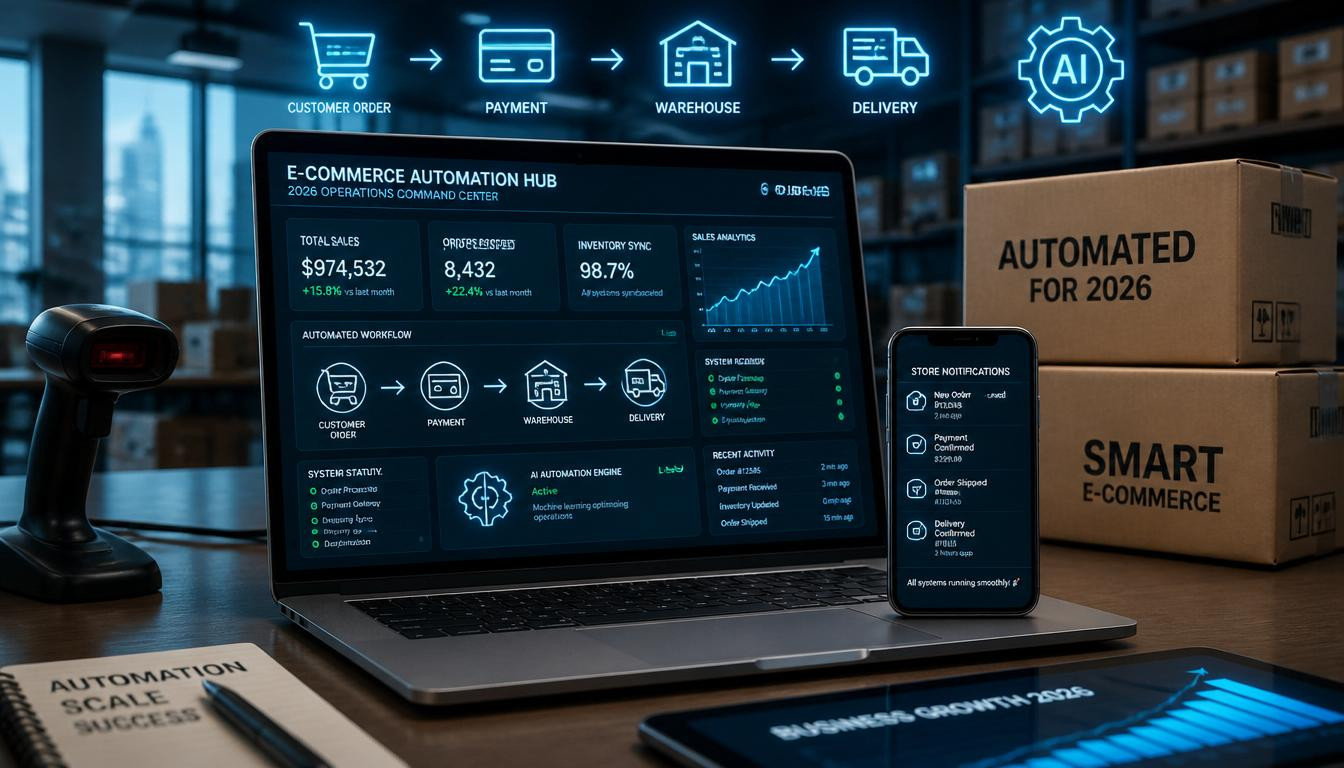
· The Stock Sync: A customer snags your very last blue XL hoodie. Now, if you manually decide to log in, it would require time and effort. But that was the past. With automation, the system itself marks the item out of stock. Take THAT, manual work!
· The Abandoned Cart Fix: A visitor on your site adds items to the cart but doesn’t check out because of an incoming call. NO WORRIES! An automated notification to them, reminding them to buy the items, saves the day.
· Instant Logistics: The moment a payment clears, your shipping labels are generated and ready to go.
It’s a total shift in your role. You stop being the person "doing" every tiny task and start being the person managing the vision. You're trading busywork for actual growth.
The Big Three: Where the Magic Happens
You have to focus on three aspects for your e-commerce store. However, automation is not limited to these.
1. Inventory & Multi-Channel Chaos
Who uses just one selling platform in 2026? Surely, you must have products listed on multiple channels. The biggest headache? Overselling. Modern tools (like Feedonomics or native platform integrations) act as the central "brain." When a sale happens anywhere, stock levels update everywhere. It stops those cringey "Sorry, we’re actually out of that" emails that kill your reputation.
2. The Customer Experience (Marketing)
Marketing isn't about "blasting" a list anymore. It’s about "flows."
· The Welcome: Greeting a new subscriber with your brand’s actual story.
· The Recovery: A timely notification can bring back 15% to 20% of lost sales.
· The Follow-Up: Sending a "How’s it holding up?" survey a week after delivery.
3. Back-Office Logistics
This is the unsung hero. Automation can route orders to the warehouse closest to the buyer, calculate real-time rates, and ping the customer with "Out for Delivery" updates. When this side is on autopilot, those "Where is my order?" support tickets, the ones that drain your team's soul, virtually disappear.
The 2026 Edge: Why You Can't Wait
This is not 2015. Times have changed drastically. Along with a good product, you have to provide an exceptional experience also. Your competitors are using these systems to scale their volume without hiring a massive team. That’s the secret to a high-margin business: stay lean, but keep the systems heavy.
Finding Your Fit: A Quick Guide
| Stage | Focus | The Move |
| Solo Founder | Sanity & Sales | Stick to built-in tools like Shopify Flows. |
| Growing Brand | Ops & Logistics | Use Zapier to "glue" your apps together. |
| Enterprise | Data & Scale | Invest in heavy-duty ERP integrations like SAP. |
The "Human Touch" Myth
People worry that automation makes a brand feel cold. That is not true. When you automate the boring stuff (like order receipts), you free up your brain to be more human where it actually matters. Focusing on other important business activities is facilitated because of automation. And that can be shooting reels of your products or interacting with the customers.
Automation is not a replacement for your voice; it is a business booster.
How to Start (Without a Meltdown)
Don’t try to fix everything at once. Use the Rule of Three:
1. Identify the task you hate the most. (Is it shipping? Inventory? Replying to the same FAQ?)
2. Find one tool to fix it.
3. Test it, then move to the next.
For most, the biggest "win" is an automated Abandoned Cart Flow. It’s low effort, high reward, and usually pays for itself in the first month.
Final Thoughts
The goal here isn't to build a business that runs without you. It is to build one that doesn't exhaust you. By handing off the repetitive, data-heavy stuff to smart systems, you reclaim your most valuable asset: your creativity.
In the end, your customers don't care if a human or a script sent their tracking number. They care that the info is right and the package is on time. Automation makes that happen every single time, whether you're at your desk or taking a much-needed Saturday off.
Ready to stop clicking and start growing? Pick one workflow today and see how much breathing room it gives you.
FAQs
1. Will using automation make my brand feel cold or robotic to customers?
No, it is the opposite of that. Customers get legit info through automation. You can use the time to engage with customers on social media. The boring activities, such as order confirmations, get done by themselves, so you can focus on core operations.
2. Is e-commerce automation only for large businesses with big budgets?
NO! Multiple tools are built only for specific platforms such as Shopify. They are very affordable also. Small businesses can use these, and if they work, then they can implement on growth and larger operations.
3. How do I know which task I should automate first?
A good rule of thumb is to look for the "3-H" tasks: anything that is High-frequency, High-volume, or Highly-boring. If you find yourself copy-pasting the same data every single day or answering the same three customer questions over and over, that is your prime candidate for automation.
4. Can automation help me sell on multiple platforms like Amazon and TikTok?
Yes, this is one of its biggest perks. Multi-channel automation acts as a central "brain" for your business. It ensures that when you sell an item on one platform, your stock levels are updated across all your other stores instantly. This prevents the nightmare of overselling products you don't actually have in stock.
5. Does "automated" mean I never have to check on my store again?
It is true that automation reduces your tasks. But you cannot completely ignore your business because of automation. Check the status once a month to ensure everything is smooth. Automation is your support that requires the periodical check.